
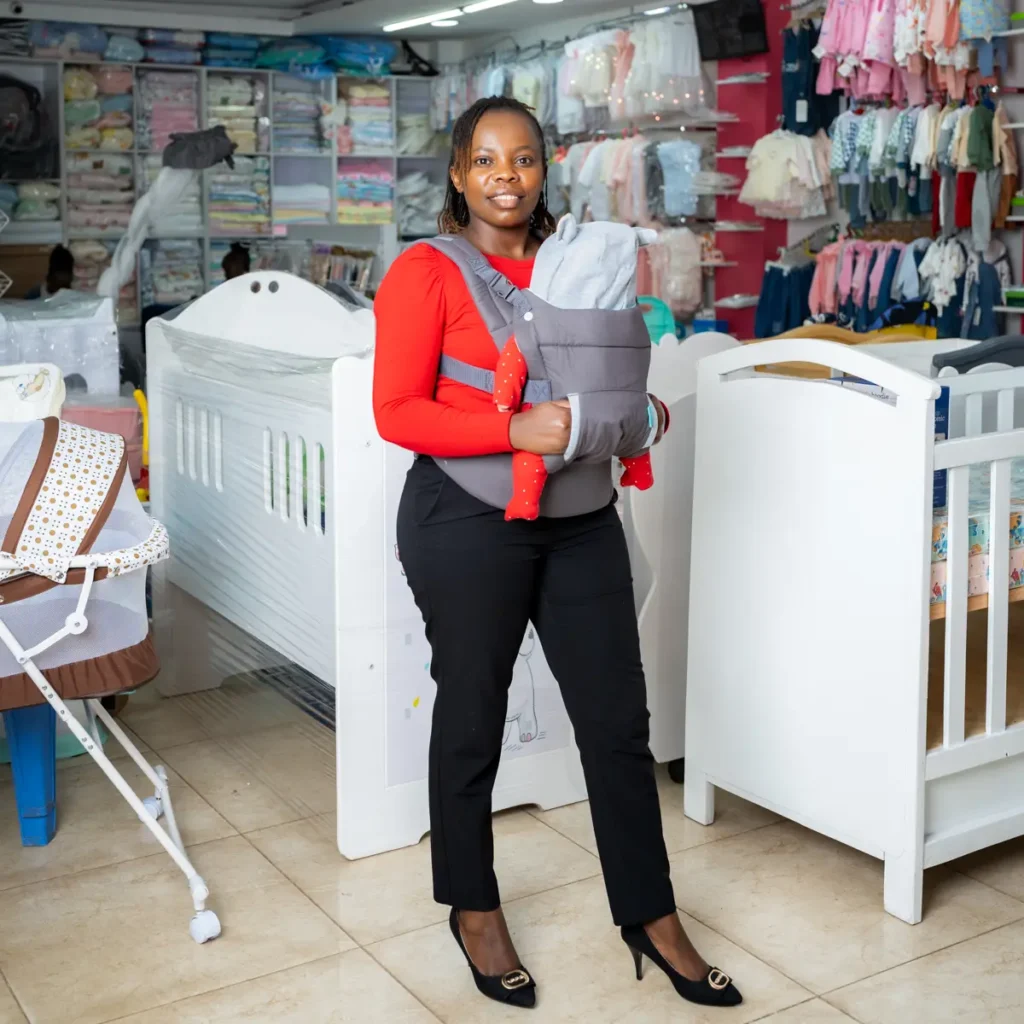
The right baby carrier holds your baby upright and facing you, with their thighs supported and knees slightly higher than their bottom. Check the weight range printed on the label before you buy, because carriers differ. At Zawadi Baby Shop, baby carriers cost KES 1,500 to 2,800 as of September 2026.
This guide compares the carrier types sold in Kenya, explains how to check a carrier fits your baby’s weight, and covers how to wear one safely. If your baby was born early, has a health condition, or your clinic is checking their hips, ask your clinic before using any carrier.
What types of baby carrier can you buy in Kenya?
Most baby carriers sold in Kenya are soft carriers: a padded panel that holds your baby against your body, with shoulder straps and a waist belt. The main differences are how many ways you can carry, whether there is a hip seat, and whether there is a hood.
- Simple soft carrier: straps and a panel, light and quick to put on.
- Multi-position carrier: lets you carry facing in, facing out or on your back as your baby grows.
- Hip-seat carrier: a padded seat on a waist belt that takes some of your baby’s weight onto your hips.
- Hooded carrier: adds a hood for sun and wind.
These are the five carriers we stock. The positions and weight ranges come from each maker’s description and box:
| Carrier | Carry positions | Weight range | Good to know | Price (September 2026) |
|---|---|---|---|---|
| Simple baby carrier | Front carry | Up to 15 kg, on the label | Adjustable straps, breathable fabric | KES 1,500 |
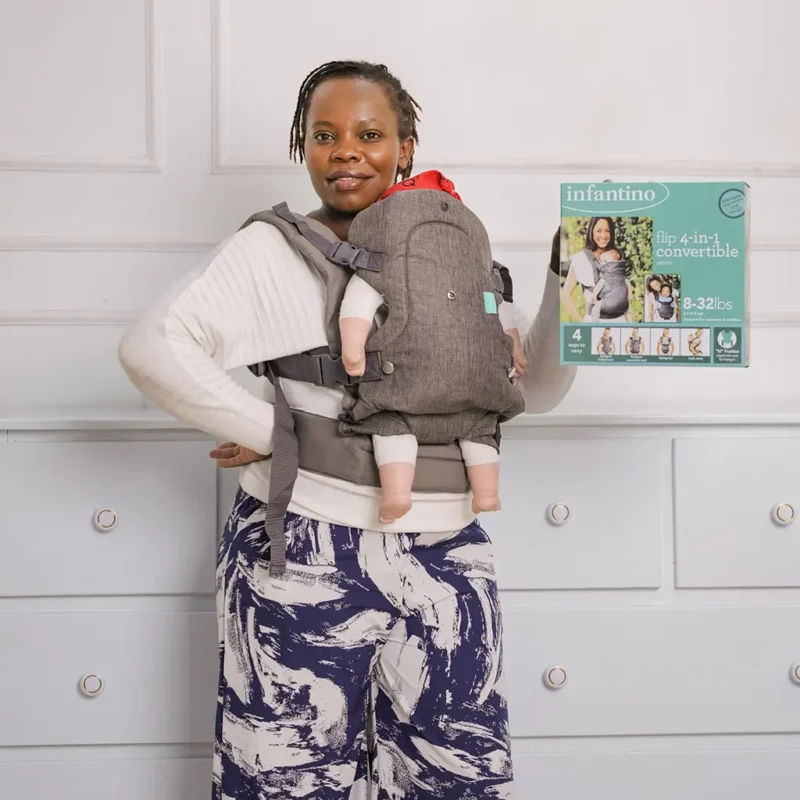
| Infantino 4-in-1 carrier | Four ways, including facing in, facing out and on your back | 8 to 32 lb (3.6 to 14.5 kg), on the box | Breathable mesh, padded straps, machine washable | KES 2,500 |
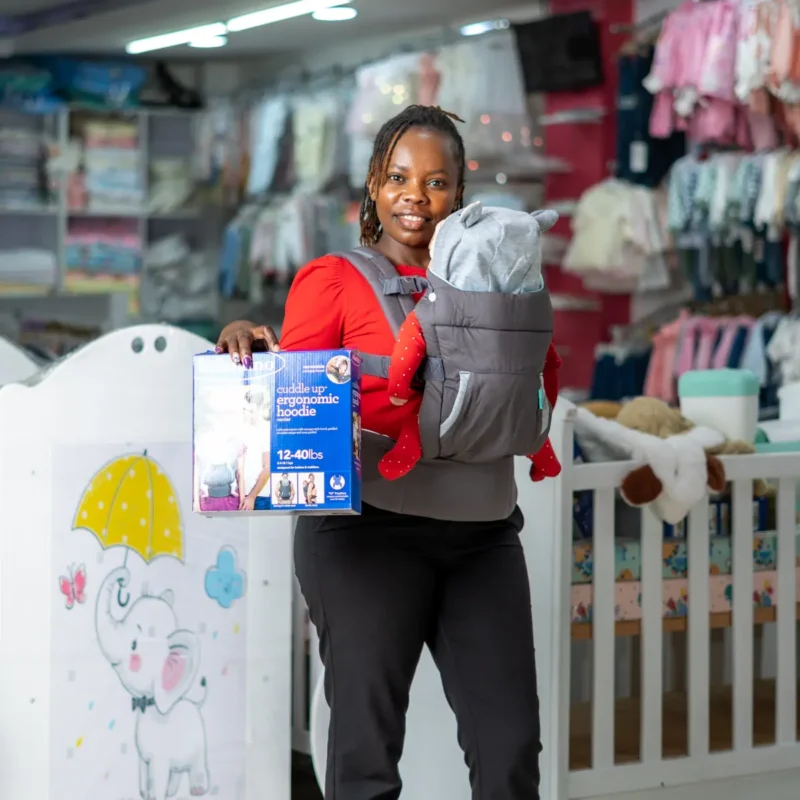
| Hooded Infantino carrier | Front carry facing in, and back carry | 12 to 40 lb (5.4 to 18.1 kg), on the box | Removable hood, lumbar support, suits bigger babies and toddlers | KES 2,800 |
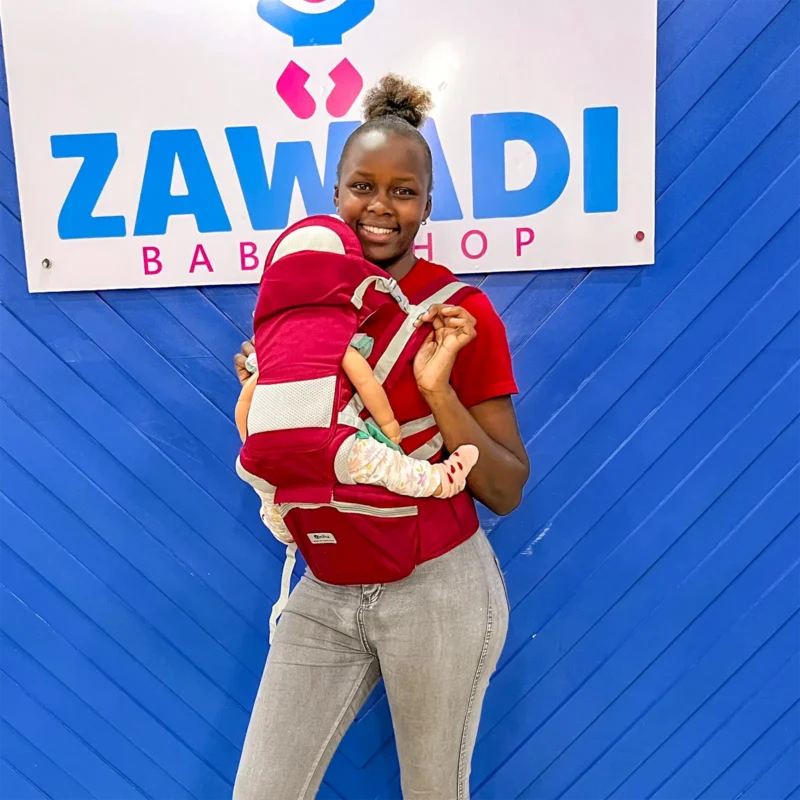
| 3-in-1 hipseat carrier | Front, hip and back | Up to 15 kg, on the label | Adjustable hip seat, padded straps | KES 2,500 |
| Aimama hipseat carrier | Hip and back | Up to 15 kg, on the label | Adjustable hip seat, padded straps | KES 2,500 |

From what age or weight can a baby go in a carrier?
A baby can go in a carrier once they weigh at least the minimum printed on that carrier’s label. Each carrier sets its own range, so there is no single starting age. For example, the Infantino 4-in-1 box gives 8 to 32 lb (3.6 to 14.5 kg), and the hooded Infantino box gives 12 to 40 lb (5.4 to 18.1 kg), so the hooded one suits an older, heavier baby.
Weigh your baby at the clinic, then compare with the label. If your baby is below the minimum weight, wait, or choose a carrier made for smaller babies. We are happy to show you the label on any carrier before you buy.
Should your baby face in or face out in a carrier?
Carry your baby facing in, towards your chest, for the first six months. The International Hip Dysplasia Institute (IHDI) recommends inward-facing carrying during this period of rapid hip development. Facing in also lets you see your baby’s face and breathing at a glance.
Some carriers also allow facing out for older babies who hold their head up well and enjoy looking around. Follow the maker’s instructions for when that position can be used.
How should a baby sit in a carrier for healthy hips?
Your baby should sit in what the IHDI calls the M-position: thighs spread around your body, and hips bent so the knees are slightly higher than the bottom, with the thighs supported. The carrier panel should be wide enough to support your baby’s thighs, not leave the legs hanging straight down.
If your clinic is following up on your baby’s hips, ask them which carrier and position to use before you start.
How do you wear a baby carrier safely?
Wear the carrier snug and upright, and check your baby every few minutes. These checks apply to every carrier:
- Keep your baby’s face visible and uncovered, including by the hood.
- Make sure your baby’s chin is off their chest, so their airway stays open.
- Hold your baby high and snug: you should be able to kiss the top of their head.
- Check every buckle and strap each time you put the carrier on.
- Bend at the knees, not the waist, when you pick something up.
- Do not cook, or carry hot drinks, while your baby is in the carrier.
Take your baby out of the carrier if they seem too hot. If your baby has any difficulty breathing, go to the nearest hospital straight away.
Which baby carrier suits you?
Choose by your baby’s weight first, then by how you will use the carrier. As a guide:
- Quick errands and matatu trips: a light carrier that goes on in seconds, such as the simple carrier.
- One carrier that grows with your baby: a multi-position carrier such as the Infantino 4-in-1.
- Heavier babies and longer walks: a hip-seat carrier, which shares the weight with your hips, or the hooded Infantino, which is made for babies from 12 lb.
- Two parents of different sizes: look for straps and a waist belt that adjust easily, and try it on together.
You can compare all five in our baby carriers range.
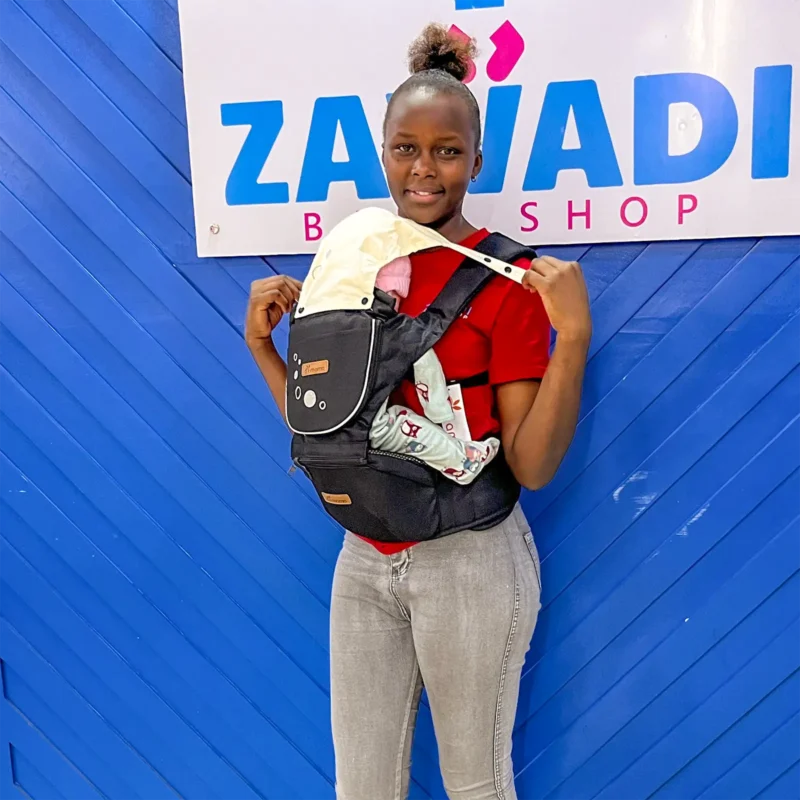
Where can you try a baby carrier in Nairobi?
You can try every carrier on, with your baby, at Zawadi Baby Shop, Shop F12, IBEA Building, Moi Avenue, Nairobi. We are open Monday to Saturday 8:30am to 7pm, and Sunday 11am to 6pm. Call or WhatsApp 0706 561 855 before you visit.
You can also order online, pay with Lipa na M-Pesa, and we deliver across Kenya. Heading out with your baby? Our guide to choosing a diaper bag covers what to pack, and our newborn shopping checklist covers everything else.
Frequently asked questions
From what age can I use a baby carrier?
It depends on the carrier. Each one prints a minimum and maximum weight on its label, for example 8 to 32 lb for the Infantino 4-in-1. Weigh your baby at the clinic and only use a carrier once your baby is within its range.
Should my baby face in or out in a carrier?
Face your baby in, towards your chest, for the first six months. The International Hip Dysplasia Institute recommends inward-facing carrying during this period of rapid hip development. Some carriers allow facing out later; follow the maker’s instructions.
Is a hip seat carrier good for a newborn?
Check the hip seat carrier’s label for its minimum weight and age before using it with a young baby. A newborn needs to sit upright and snug, facing you, with the thighs supported. We can show you the label in the shop.
How much is a baby carrier in Kenya?
At Zawadi Baby Shop, baby carriers cost KES 1,500 to 2,800 as of September 2026. The simple carrier is KES 1,500 and the hooded Infantino is KES 2,800. Prices change, so check the product page for the current price.
How do I know my baby is sitting correctly in the carrier?
Your baby should sit high and snug with their face visible, chin off their chest, and legs in an M shape: thighs supported and knees slightly higher than the bottom. You should be able to kiss the top of their head.

About the author
Kui Thairu
Founder and director, Zawadi Baby Shop
Kui Thairu is the founder and director of Zawadi Baby Shop, the baby store at Shop F12, IBEA Building, Moi Avenue, Nairobi, which has served Kenyan parents since 2018. She built the shop around one idea: only stock what she would be proud to hand over the counter. Her guides share the practical buying advice she and her team give parents in the shop every day. For anything medical, she always points parents to their clinic.